





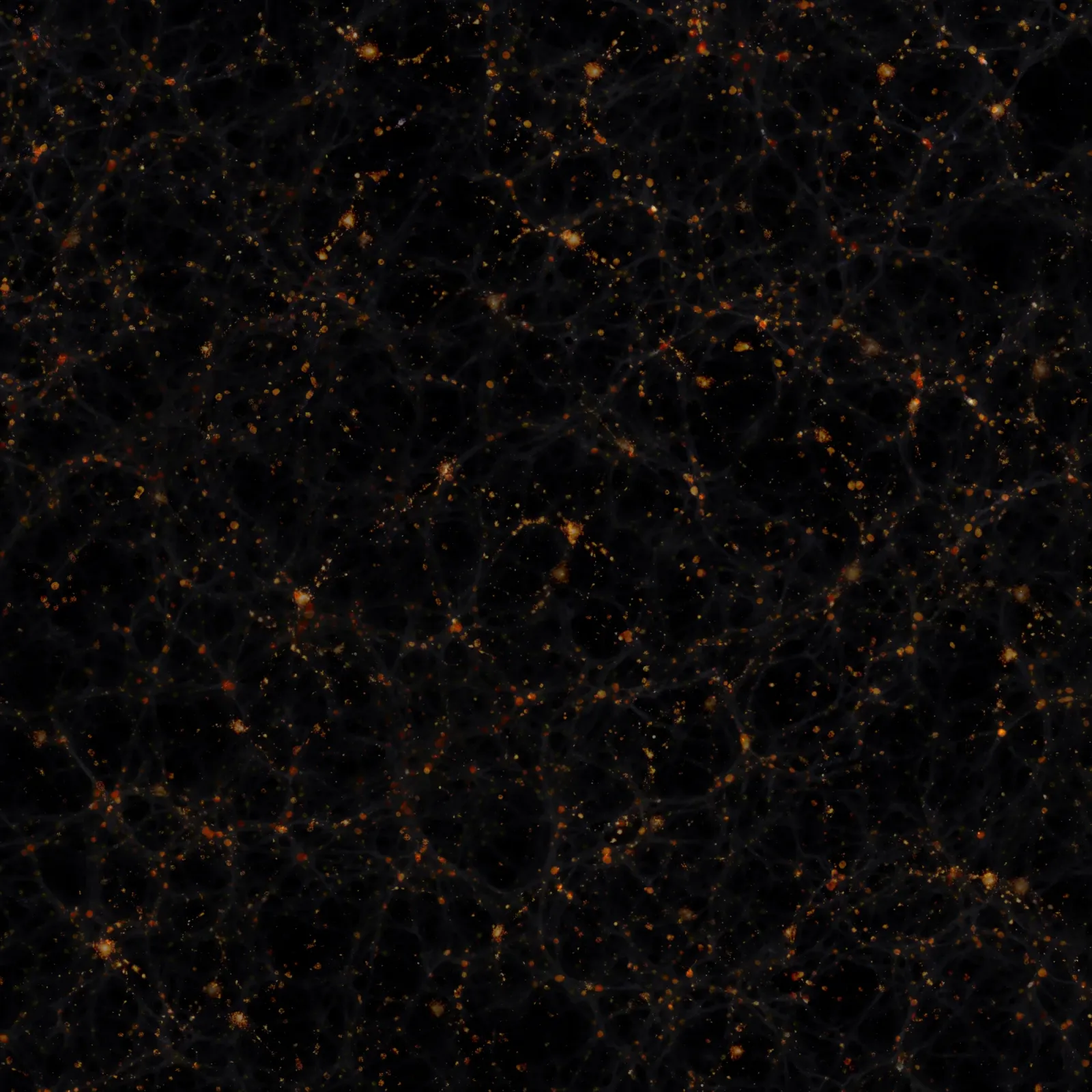
Scientists have directly observed a cosmic filament connecting two galaxy clusters splitting its flow toward both clusters. The study was conducted by the Shanghai Astronomical Observatory of the Chinese Academy of Sciences and other institutions using galaxy spectra from the Sloan Digital Sky Survey.
The researchers used the geometry of cluster pairs to separate the effects of cosmic expansion from the motion of matter. They estimated and subtracted the background redshift using the positions of the clusters at either end of the filament; the remaining excess redshift reflected the filament’s own inflow.
The team selected cluster pairs separated by 2–6 Mpc and analyzed spectra of galaxies in the filament region between them. The measurements showed that the velocity profile reverses near the midpoint: the section closer to one cluster flows toward it, while the section near the other flows toward that cluster.