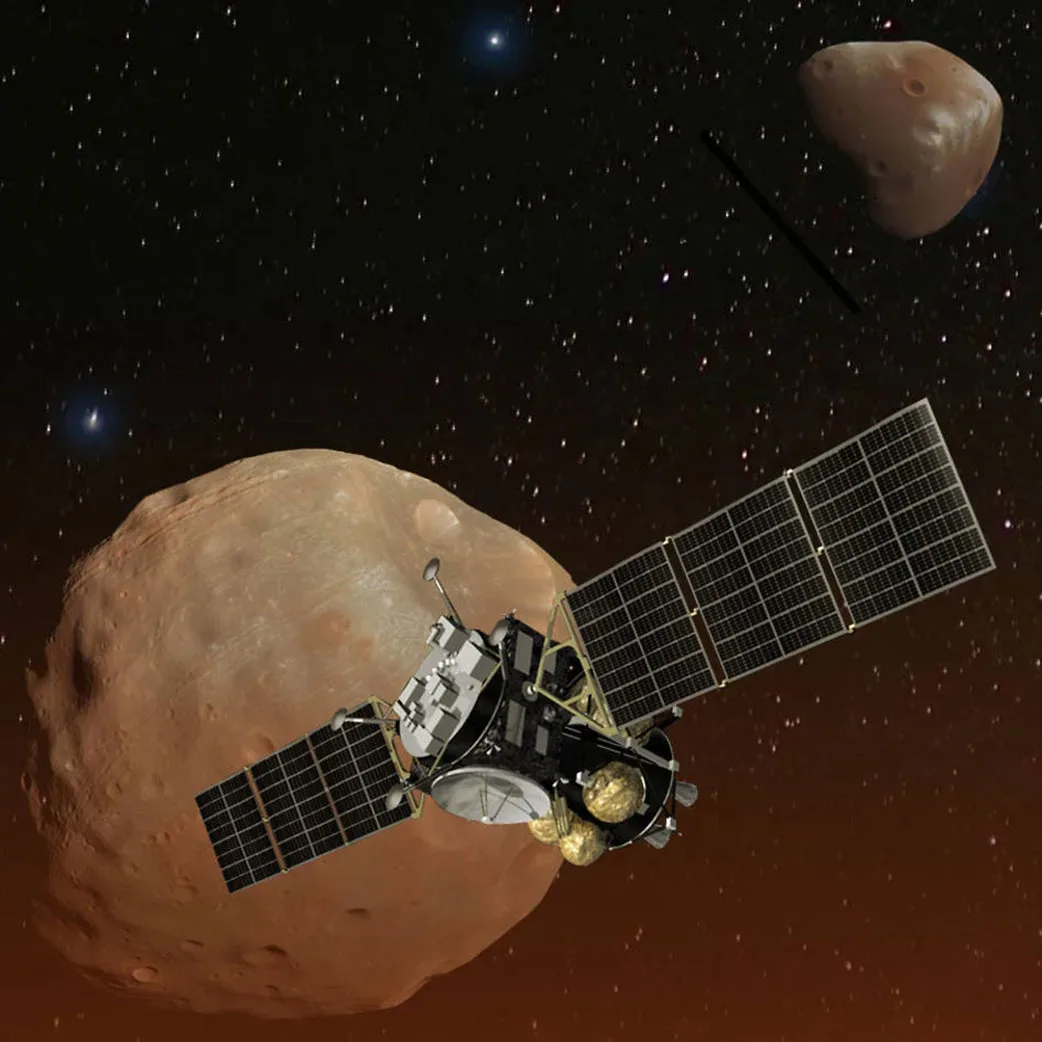
NASA is contributing to the Japan Aerospace Exploration Agency’s MMX mission to investigate Mars’ moons. The mission aims to characterize Phobos and Deimos, determine their origins, and deliver a sample from Phobos to Earth.
The spacecraft is targeting launch from Japan’s Tanegashima Space Center at 3:41 p.m. EDT on Oct. 19, or 4:41 a.m. JST on Oct. 20.
NASA’s contributions include the MEGANE spectrograph, a demonstration of the P-Sampler collection technology, and communications and navigation support through the agency’s Deep Space Network. NASA is also funding U.S. scientists on the MMX science team.
MEGANE will measure neutrons and gamma rays emitted from Phobos’ surface to help determine its chemical composition. Mounted on a spacecraft landing leg, the P-Sampler will collect surface material using bursts of high-pressure nitrogen; JAXA’s C-Sampler will extract cores from a few inches deeper.
NASA will receive and curate about 15% of the returned sample at the Astromaterials Lab at the agency’s Johnson Space Center in Houston, making it available for research.
Scientists are investigating whether Phobos and Deimos formed from material thrown into orbit by a major impact on Mars or are asteroids captured by the planet’s gravity billions of years ago. MMX data and samples are expected to help answer questions about the moons’ origins and the history of the solar system.
The spacecraft is scheduled to arrive at Mars in August 2027 and begin surveying its two moons. It will collect a surface sample from Phobos no earlier than December 2028 and deliver it to Earth in 2031.